sajaforum archive

SAJAforum: OBIT: K.G. Kannabiran, India’s “Leading Civil Liberties Lawyer for the Last Four Decades”

K.G. Kannabiran, one of India’s “leading civil liberties lawyers for the last four decades,” died on December 30, 2010, at age 81. A biographical sketch, from the Hindu:

Born in 1929, Mr. Kannabiran obtained master’s degree in Economics and a degree in law from the Madras University before shifting to Hyderabad to set up legal practice in 1961. Since the late 1960s, he began to defend political dissenters that eventually marked the beginning of his over three-decade-long civil liberties and human rights work.

He was the president of Andhra Pradesh Civil Liberties Committee between 1978 and 1994 and went on to become the national president of People’s Union for Civil Liberties (PUCL).

* * *

He was a member of Concerned Citizen’s Tribunal that inquired into the Gujarat carnage. Earlier, he was appointed as senior counsel by the CBI in the prosecution of the accused in the Shankar Guha Niyogi murder case in Madhya Pradesh.

During the Emergency, he defended numerous political detainees and appeared in four major conspiracy cases — three of them in Andhra Pradesh — that had been filed to suppress political dissent.

In 1971, he filed a writ petition successfully challenging the Andhra Pradesh Preventive Detention Act, 1970, under which writers, poets and intellectuals had been arrested. [The Hindu]

Many of Kannabiran’s writings are collected in a 2004 book, “The Wages of Impunity: Power, Justice and Human Rights.”  His funeral was conducted “quietly” soon after he passed away, as his wife, Vasanth Kannabiran, explained in a guest post on Kafila:

As per his wishes and ours, and based on previous discussions we declared that the last rites would be simple, speedy and secular. The secular part we ensured. There were no flowers, no lamps, no mantras, no ceremonies. But the clamour for progressive “traditions” was what I found troubling in the extreme. In doing away with religious orthodoxy, all we have done is replaced it with other orthodoxies….

We all need symbols and some reassurance. But the slogans we raise however loud and clear – can Kanna hear them? Will they, like the traditional mantras, take his soul to heaven? Who are we reassuring? Why are we afraid of silence? Why are we making our radical orthodoxies more rigid and meaningless than the reactionary ones? What is reactionary and what is radical? Why are we in such haste to raise monuments to the people we love? If Kannabiran cannot live in the hearts of people, are tributes and memorials going to bring him to life? To be loud in praise is easy. It dies out in a moment….

* * *

Instead of recreating the dead man in imaginative ways that would bring him alive to the public that loved him, we would rather show the dreary details of his funeral. How many people? How many placards? How many organizations? … It is not enough to write obituary pieces and hold meetings without any reflection of our conduct and attitudes.

The dead need no reification. Kannabiran was the voice of the poor. He never projected himself. He never needed to. [Kafila]

Here are a handful of remembrances reflecting upon Kannabiran and his work. Continue reading at SAJAforum…

PAKISTAN FLOODS: TIME Removes Pakistan Floods Story from Cover of US Edition (SAJAforum)

(Posted at SAJAforum)

Via Climate Progress:

[T]he big new Time magazine cover story for their European, Asian, and South Pacific editions, Through Hell And High Water, doesn’t make the cut for the U.S. edition’s cover (as the screen capture [below] shows).  In fact, can someone tell me if it made the print edition at all, since I can’t find the story in the table of contents?

Equally significant, the Time story itself never mentions the link to climate change or global warming at all, even though it is pretty basic physics…. [link

Time-cover-Pakistan[1]

What does in fact “make[] a school great,” you ask?  You won’t find this in TIME Magazine, but at least according to a pair of reports [one, two] reprinted on the Asia Society website back in September 2008, it is “crucial” for U.S. schools to improve students’ development of “international knowledge and skills.” Ahem.

[HT: Manan Ahmed]

Related post on SAJAforum: NATURAL DISASTERS: How you can help the Pakistan flood victims

SAJAforum: PAKISTAN: An Update on Internally Displaced Persons

Back in July 2009, we took note of what experts then were calling an “impending humanitarian disaster“: the displacement of as many as 2.5 million individuals due to the government’s military offensive in the North-West Frontier Province. Soon thereafter, the Pakistan government announced plans to return displaced individuals to their homes, and mainstream news coverage of the crisis subsided and public attention turned elsewhere.

Seven months later, how does the situation look for internally displaced persons? Writing at Changing Up Pakistan, Kalsoom Lakhani provides an update, arguing that although the IDP situation has been “out of the headlines,” the crisis remains severe….

Continue reading at SAJAforum….

SAJAforum: UK: BBC Asian Network on the Chopping Block?

Bbc_anWhen the BBC Asian Network was launched back in 2002 as a nationwide digital radio station throughout Britain, the BBC’s then-radio director, Jenny Abramsky, called it “one of the most important things the BBC has ever done.”  Since then, the Asian Network has developed a loyal following, both in Britain and, via the internet, around the world.

[Because of immigration patterns, "Asian" is the UK word for South Asians.]

Today, however, the Asian Network’s future is very much in doubt. On the eve of British general elections, a strategy review by BBC management proposes major changes in the BBC’s operations — including the closure of the Asian Network (and another network, BBC 6 Music) altogether….

Continue reading at SAJAforum….

SAJAforum: PAKISTAN: An “Impending Humanitarian Disaster”

PK - CampsThat’s what Audil Rashid and Mian Nazish Adnan sound the alarm about in the July 4, 2009 issue of the British medical journal The Lancet, following their recent visits to camps set up to house internally displaced persons (IDPs) fleeing the conflict zone in Pakistan’s North-West Frontier Province. While Americans celebrate the Independence Day weekend with barbeques and fireworks, Rashid and Adnan paint a grim picture of the crisis in Pakistan:

From the very beginning it was evident that the government had underestimated the human cost of the military operation. As several camps were hastily set up to cater to the massive influx of IDPs, reports about the lack of even basic amenities in these camps began to emerge. Excessive heat (daytime temperatures soaring to 40°C and above), no electricity, food and water shortages, poor sanitation, and lack of proper health care are some of the immediate problems being faced by IDPs….

Lack of proper toilets and sanitation, unsafe drinking water, infrequent bathing, high air temperatures, inadequate disposal of solid waste, and the complete absence of a proper drainage system at the refugee camps are the main causes of worry for relief health workers. “This is the making of a disaster. These camps have been established on open tracts of land used for agricultural purposes. There are snakes, rats, and scorpions here. At night, when it is pitch dark because of no electricity, people sleep on the ground and are vulnerable to snakebites”, said M Idrees Mirza, a doctor who runs a private clinic in Rawalpindi city and is working voluntarily in the
camps.

PK Camps - Map“Conditions in these camps make them perfect breeding areas for mosquitoes and many varieties of insects. In my opinion, there is a very high probability of an outbreak of any disease like mumps, measles, scabies, malaria, diarrhoea, polio, and leishmaniasis”, said another health worker working for a respected NGO who spoke to The Lancet on condition of anonymity. “We need medicines, doctors, and qualified health workers. And we need them urgently. Any delays might result in a human catastrophe of unimaginable proportions.”….

Eager to establish its writ over the Swat Valley, the government seems to have created a health crisis which it may not be able to overcome. [link; registration req'd]

Two letters in the same issue of The Lancet offer additional details. But as dire as the situation has become within the camps, K.M. Bile and Assad Hafeez note in one of those letters that the government camps house only 20 percent of the IDPs — who may now total as many as 2.5 million individuals, almost half of them children:

Without counting the great costs to themselves, families in the local community are looking after more than 1·73 million people, in accordance with the local tradition of hospitality. Most displaced people have been accommodated within family homes; others are in schools, mosques, and other community buildings…. Although a proportion of host families are related to or friends of the displaced people, many have welcomed strangers. [link; registration req'd]

Continue reading at SAJAforum….

SAJAforum: “Did you have something to do with that?”

Times Now correspondent Simrat Ghuman was “walking on air” after President Obama called on her to ask a question during his news conference at the G-20 summit in London. (Is it just me, or does that number seem to change every year, and entirely without warning?) Apparently, Ghuman was so high in the clouds that she couldn’t help but interrupt Obama’s answer:

QUESTION: Hi, Mr. President.

OBAMA: How are you?

QUESTION: Thank you for choosing me. I’m very well. I’m (inaudible) from the Times of India.

OBAMA: Wonderful.

QUESTION: You met with our Prime Minister Manmohan Singh. What did you — what are you — what is America doing to help India battle terrorism emanating from Pakistan?

OBAMA: Well, first of all, your prime minister is a wonderful man.

QUESTION: Thank you. I agree.

(LAUGHTER)

I agree.

OBAMA: You know, did you have something to do with that?

(LAUGHTER)

You seem to kind of take credit for it a little bit there.

(LAUGHTER)

QUESTION: We’re really proud of him, so…

OBAMA: Of course. You should be proud of him. I’m teasing you. I think he’s a very wise and decent man and has done a wonderful job in guiding India, even prior to being prime minister, along a path of extraordinary economic growth that is a marvel, I think, for all the world…. [link]

Must-see video of the entire exchange (including Obama’s full response) is above, and the rest of Obama’s answer appears after the jump. No word on whether Prime Minister Singh is now “walking on air” as well. However, the next time someone tells me that Sree Sreenivasan and Arun Venugopal are “wonderful men,” I’ll be tempted to interrupt and say “thank you.”

Unfortunately, Ghuman’s pride in her Prime Minister stole some of the media oxygen from the actual response to her own question. However, as the Associated Press notes, in his response Obama said that “in a nuclear age, at a time when perhaps the greatest enemy of both India and Pakistan should be poverty, … it may make sense to create a more effective dialogue between India and Pakistan.”

Continue reading at SAJAforum….

SAJAforum: UN Official Alleges War Crimes in Sri Lanka’s Escalating Civil War

Sri Lanka (map: BBC)The civil war in Sri Lanka has attracted greater international scrutiny within the past week, with UN High Commissioner for Human Rights Navi Pillay suggesting that both the government of Sri Lanka and the Liberation Tigers of Tamil Eelam (LTTE) may have committed war crimes:

Warning that the loss of life may reach “catastrophic levels,” [Pillay] urged the government and Liberation Tigers of Tamil Eelam (LTTE) rebels to halt hostilities to allow the evacuation of civilians trapped on the northeastern coast.

Pillay said the government had repeatedly shelled the designated “no-fire” zones for civilians and also cited reports the separatist
guerrillas were holding civilians as human shields and had shot some as they tried to flee.

“Certain actions being undertaken by the Sri Lankan military and by the LTTE may constitute violations of international human rights and humanitarian law,” Pillay said in a statement.

“The world today is ever sensitive about such acts that could amount to war crimes and crimes against humanity,” added the former
U.N. war crimes judge, who is a member of the Tamil ethnic group and grew up in South Africa.

Pillay called on Sri Lanka’s government to grant full access to U.N. and other aid agencies to monitor human rights and humanitarian conditions amid reports of “severe malnutrition” among those trapped. [link]

Pillay stated that as many as 2,800 civilians have been killed and over 7,000 injured since January, and that as many as 180,000 civilians may be trapped in the conflict zone.

Others in the international community have raised similar concerns. According to the International Committee for the Red Cross, the humanitarian situation faced by civilians in the conflict zone is “deteriorating by the day.” Former special advisor to the UN Secretary General Lakhdar Brahimi says that the humanitarian crisis places Sri Lanka “on the brink of catastrophe.” In a phone call to to Sri Lanka’s President Mahinda Rajapaksa, U.S. Secretary of State Hillary Rodham Clinton expressed “deep concern” about escalating civilian deaths and urged the Sri Lankan Army “not [to] fire into the civilian areas of the conflict zone.” The European Union has also called for a cease fire to permit trapped civilians to escape the fighting.

Sri Lanka disputes the UN’s figures — the LTTE, the government asserts, has “infiltrated certain personalities into these agencies” — and has rejected calls for a cease fire. More details are available in two stories from the BBC World Service’s Evening Report, linked above (and here and here). However, according to the Christian Science Monitor:

[T]he sensitive data aired by Ms. Pillay were based on firsthand daily reporting by UN national staff and aid workers trapped in the no-fire zone. A copy of a recent UN briefing paper that was obtained by the Monitor listed similar casualty figures and described mounting casualties in the squalid, densely packed coastal strip. “Daily incoming artillery and mortar fire has caused large number of casualties with a noted increase since 26 Feb,” it said.

The briefing paper said several weeks of food and medicine shortages had led to deaths from malnutrition and from preventable diseases. [link]

Meanwhile, SAJAer Angilee Shah has published a feature article in the Far Eastern Economic Review (which was reported from Colombo, Singapore, and Los Angeles with the support of a SAJA Reporting Fellowship) critically examining the consequences of the Rajapaksa government’s aggressive approach to prosecuting the civil war:

Continue reading at SAJAforum….

SAJAforum: BBC Journalists to Strike Over Proposed “Offshoring” of South Asia Services

BBC World ServiceJournalists from across all services of the BBC have resolved to hold two one-day strikes next month, prompted in large part by plans to “offshore” operations for the BBC World Service’s Hindi, Nepali, and Urdu language programming to Delhi, Kathmandu, and Islamabad. From the Guardian:

TV, radio and online news will be disrupted on Friday 3 April and Thursday 9 April after nearly 800 members of the National Union of Journalists chapel at the BBC today voted in favour of industrial action in a national ballot.

More than 1,100 of the union’s nearly 4,000 members at the corporation took part in the vote, 77% of whom voted in favour of a strike.

The most urgent threat of compulsory cuts is at the World Service’s South Asian section, where up to 20 members are at risk, the union has said. Staff in Scotland are also understood to be under threat.

The NUJ general secretary, Jeremy Dear, said: “Journalists at the South Asian services have been fighting a heroic struggle against the outsourcing of their jobs … now they have the weight of thousands of NUJ members at the BBC behind them.” [link]

In late February, journalists within the South Asia services held their own one-day strike to protest the proposed restructuring. In addition to worrying about lost jobs in London, the journalists fear that shifting operations to the subcontinent would compromise the quality and independence of the BBC’s coverage:

Striking members of the BBC’s South Asia service on February 26, 2009 (Photo: BECTU)Staff are concerned that moving production of these BBC language services abroad will result in poorer output and a loss of independence which is integral to the BBC World Service.

One member commented: “If the BBC’s succeeds in imposing change, the tendency will be for the output to become more and more India-centric, in the case of the India service, as they try to compete with local FM broadcasters.

“This moves away from the World Service’s USP: impartial news with a global perspective. Why should the British taxpayer end up paying for a local Indian radio station?” [link]

The International Federation of Journalists has echoed these concerns, asserting that “the BBC management’s off-shoring plans will put at risk seventy years of first-class journalism and expose their journalists to political and commercial pressures beyond their control.” On the eve of last month’s one-day strike, John McDonnell, a Labour MP for west London, elaborated upon these concerns even further:

Continue reading at SAJAforum….

SAJAforum: BREAKING NEWS – Iftikhar Muhammad Chaudhry Reportedly to Be Restored as Chief Justice of Pakistan

Chief-justice-iftikhar2-300x295[1]Via Reuters (and Sadia Abbas), some breaking news from Pakistan:

The Pakistan government agreed on Monday to reinstate Iftikhar Chaudhry as Supreme Court chief justice to end a political crisis that has gripped the Muslim nation, a government official said.

The official added that a constitutional package would also be presented.

President Asif Ali Zardari had hitherto stonewalled calls from the opposition led by former prime minister Nawaz Sharif and a lawyers’ movement to restore the judge.

Chaudhry was dismissed in late 2007 by then-president and army chief
Pervez Musharraf, but Zardari regarded the judge as too politicized and
feared he could pose a threat to his own presidency if restored. [link]

No solid confirmation as yet, but Prime Minister Yousaf Raza Gilani is scheduled to address the nation shortly.

Continue reading at SAJAforum….

SAJAforum: Geo TV Blocked, Sherry Rehman Resigns

3-14-2009_71429_l[1]Everything old appears to be new again in Pakistan. The latest: government bans on independent television news coverage.

On the heels of an emergency crackdown earlier this week, in which the government of President Asif Ali Zardari responded to the “Long March” organized by the lawyers movement by banning public gatherings and reportedly detained hundreds of opposition lawyers and political workers, Zardari has also moved to block transmission of Geo TV throughout the country:

On the direct order of President Asif Ali Zardari, the transmission of the Geo News was blocked by cable operators in various parts of the country on Friday, which drew flak from across the country.

The transmission was blocked in some parts of Karachi, Hyderabad,
Islamabad, Rawalpindi, Lahore, Quetta, Multan, Rawalakot, Muzaffarabad, Deepalpur, Sargodha, Nawabshah, Faisalabad, Gujranwala and Dera Murad Jamali. [link]

Geo and other TV news channels were previously blocked — for much the same reasons as the present ban by Zardari — by Gen. Pervez Musharraf, first as the lawyers’ movement was gaining momentum in the spring of 2007 and later after Musharraf declared a state of “emergency” in November 2007.

The Geo ban has apparently prompted the resignation of Information Minister Sherry Rehman, a leading member of the Pakistan People’s Party and close confidante of the late former Prime Minister Benazir Bhutto:

Continue reading at SAJAforum….

SAJAforum: Quantifying India’s Encounter Deaths and Disappearances

Graph-encounterIn recent weeks, human rights violations in India have slowly been seeping into the mainstream Western consciousness — and not just because of Sergeant Srinivas. A flurry of media stories and human rights reports draws attention not only to particular extrajudicial killings, disappearances, and incidents involving torture at the hands of Indian police and security forces, but also to the prospect that such incidents may be part of more systematic patterns of abuse than is typically assumed.

Both the New York Times and Time have published stories within the past month discussing the prevalence of so-called “encounter killings” in India:

Numbering in the thousands every year, “encounters” or “encounter killings” are shootouts between the Indian police or army and any criminal element, from terrorists to petty thieves. Many Indians believe that at least some are stage-managed — with, say, a police officer placing a gun in the hands of a dead person — leading to the popular phrase, “fake encounter killing.”…

In almost all, India’s limited forensics capabilities make investigating the claims of either side hard to verify. But the national news media often accept the police’s version,which puts them in harmony with many in their middle-class audience who fear rising crime and terrorism. Meanwhile, Bollywood and Indian media lionize “encounter specialists” — soldiers or policemen who, like Dirty Harry, specialize in shootouts. [NYT]

* * *

Human rights activists have for years protested the growing incidence of encounters, some of them allegedly staged. “Encounters have become the norm,” says Vrinda Grover, lawyer and human rights activist. “They have become the police’s preferred method to deal with not just terrorists, but criminals of all kinds.” Legends of “encounter specialist” cops abound, and one of them was even the subject of the Bollywood film Ab Tak Chhappan (“So far 56″, implying the number of people he had killed).

Activists allege that in numerous instances, evidence has been planted after a shooting in order to justify police claims that officers had acted in self defense. Encounters are meant to be probed by a magistrate following a post-mortem, but critics point out that the investigative work in such probes is undertaken by the police themselves. They also allege that such tactics enjoy tacit approval from the authorities in areas plagued by insurgencies. [Time]

Continue reading at SAJAforum….

SAJAforum: Religious pluralism and our new president

The Obamas and the Bidens at the Inaugural Prayer Service (Donvan Marks)
In his inaugural address, President Barack Obama made a point of proclaiming:

“[the United States's] patchwork heritage is a strength, not a weakness. We are a nation of Christians and Muslims, Jews and Hindus – and non-believers. We are shaped by every language and culture, drawn from every end of this Earth.”  [link]

This morning, at the Washington National Cathedral, the Inaugural Prayer Service extended Obama’s message of spiritual pluralism by including participants from a variety of different religious traditions. Ingrid Mattson, president of the Islamic Society of North America, and Uma Mysorekar, president of the Hindu Temple Society of North America, were two of the six participants to give responsive prayers during the service.

SAJAforum readers may recall Mysorekar from her appearance on The Colbert Report and her efforts to have Diwali placed on New York City’s official “parking holiday” calendar. Mattson, who is a professor of Islamic Studies and Christian-Muslim Relations at Hartford Seminary, is “the first woman, the first nonimmigrant and the first Muslim convert” to be elected as ISNA’s president.

The video of the service is available here, and the text of both Mattson’s and Mysorekar’s responsive prayers appears in the official program for the service:

Continue reading at SAJAforum…

SAJAforum: Five questions for South Asians for Obama

IMG_4424In 1993, the last time I was in Washington to attend a presidential inauguration, Representatives Robert Matsui and Norman Mineta cohosted the first significant Asian American reception in connection with any U.S. presidential inauguration. While some attendees had mixed feelings, since by then it had become clear that President Clinton’s initial round of cabinet nominees would not include any Asian Americans, there was nevertheless a sense that the Asian American community had marked an important political milestone.

Fast forward sixteen years: The president-elect is a biracial, second generation American who grew up in Hawaii and considers himself desi. South Asians and other Asian Americans feature prominently in both the transition and the new administration’s significant appointees. And in contrast to that one Capitol Hill reception in 1993, Washington is chock full of Asian American events in connection with the inaugural celebration, including several South Asian-oriented gatherings.

South Asians for Obama
got a jump on the festivities on Saturday evening, hosting an informal happy hour which drew over 300 attendees. One of the group’s cofounders, Hrishi Karthikeyan, took some time out of his inaugural week schedule to answer a few questions.

Continue reading at SAJAforum…

SAJAforum: Muslim conference prompts gay-evangelical love, peace, harmony

Ahmad-EtheridgePresident-elect Barack Obama‘s selection of conservative fundamentalist minister Rick Warren, who supported California’s Proposition 8 in last month’s elections, to deliver the invocation at the presidential inauguration has caused many of Obama’s progressive supporters to feel a sense of “betrayal,” as Neil Buchanan has written at Dorf on Law. Singer, songwriter, and Prop 8 opponent Melissa Etheridge, who is openly lesbian and has been a longtime activist for gay rights and other progressive causes, had much the same initial reaction. While she had never previously heard of Warren, she wondered whether Warren was a “hate spouting, money grabbing, bad hair televangelist like all the others,” and whether she should boycott the inauguration on account of his selection.

Given the controversy, Etheridge was “stunned” to learn that Warren would be giving the keynote address at the Muslim Public Affairs Council’s annual convention in California — where Etheridge herself was scheduled to appear with Junoon’s Salman Ahmad to perform “Ring The Bells,” a song they had co-written “call[ing] for peace and unity in our world.” (Since December, apparently, is “Using Music to Change the World Month,” the MPAC performance was intended to initiate a broader “Ring the Bells for Peace” Campaign, which you can read more about here.)

Etheridge says that she initially contemplated canceling her appearance at MPAC on account of Warren’s appearance. However, as she recounts at the Huffington Post, Etheridge ultimately decided on a different approach to the situation:

Continue reading at SAJAforum…

SAJAforum: Valuing Different People’s Lives

We’ve previously noted the Guardian‘s observation of a disconnect in coverage of last month’s terrorist attacks in Bombay, between “headlines of wealthy westerners fleeing Mumbai’s terror frontline” and “ordinary Indians who bore the brunt of the bloody attack[s].” This week, a handful of articles explore similar themes, this time concerning media and public responses to the attacks within India itself.

Continue reading at SAJAforum…

SAJAforum: Sri Lankan Perspectives on the Bombay Attacks and Their Aftermath

This weekend, The Guardian reminded us that “[b]ehind the headlines of wealthy westerners fleeing Mumbai’s terror frontline, it was ordinary Indians who bore the brunt of the bloody attack[s]” in India’s financial and cultural capital this past week. Those same headlines might easily lead one to conclude that the Bombay attacks are significant only or primarily for their geopolitical, economic, and personal consequences for people in the West.

However, the attacks and their aftermath are certainly being experienced rather acutely throughout the South Asian subcontinent itself and within South Asian diaspora communities in other parts of the world. Take, for example, Sri Lanka. Certainly, the people of Sri Lanka have plenty else on their minds these days, with military clashes between the government and the Tamil Tigers proceeding apace and major floods destroying thousands of homes and displacing tens of thousands of people, many of whose lives already had been disrupted by the ongoing fighting. Nevertheless, these serious events — each worthy of greater international media attention in its own right — have not kept Sri Lankans from also experiencing the ramifications of this week’s Bombay terrorist attacks.

Continue reading at SAJAforum…

SAJAforum: Chief Justice Iftikhar Muhammad Chaudhry of Pakistan to accept NYC Bar honor

Chief Justice of Pakistan Iftikhar Muhammad ChaudhryOn Monday, November 17, 2008, Pakistan’s ousted Chief Justice, Iftikhar Muhammad Chaudhry, will be in New York to speak at the New York City Bar Association and to accept an Honorary Membership, which is one of the Association’s highest honors. The invitation to receive the award was originally extended to Chaudhry in October 2007, following a unanimous recommendation by the Association’s honors committee a month earlier, but Chaudhry was unable to come to New York to accept the award, since he was detained for several months under house arrest after General Pervez Musharraf’s extraconstitutional suspension of the Pakistan Constitution in November 2007. The New York City Bar ultimately conferred the award in absentia in January 2008, breaking with the Association’s longstanding policy requiring honorees to accept the recognition in person.

Chaudhry is the eighth individual to be conferred honorary membership by the New York City Bar. Prior recipients include former Chief Justice of the United States William Rehnquist, former Chief Justice of India P.N. Bhagwati, and Judge Thomas
Buergenthal of the International Court of Justice.

Continue reading at SAJAforum….

SAJAforum: Musharraf’s “Emergency” – One Year Later

REUTERS/Faisal Mahmood: Pakistan's deposed Chief Justice Iftikar Chaudhry (C) addresses a lawyers' convention on the first anniversary of the imposition of emergency rule by then president Pervez Musharraf in Rawalpindi, November 3, 2008.One year ago today, Pakistan’s former President and Chief of Army Staff Pervez Musharraf imposed an extraconstitutional “state of emergency,” which his critics described as a full-scale, martial law crackdown. To refresh your recollections, have a look at last year’s SAJAforum posts on both the imposition of emergency rule itself and the world’s reactions.

Musharraf himself is now gone from the political scene, having resigned in August, but the legacy of his Emergency is being remembered today in Pakistan and around the world.

Amnesty International’s Asia-Pacific Director, Sam Zarifi, laments that one year later, Pakistan “is still suffering from the abusive policies [Musharraf] put in place” during last year’s crackdown:

The new civilian government which replaced Musharraf has taken some steps to improve on Pakistan’s poor human rights record, but it could and should do more, starting immediately with declaring the 2007 dismissal of judges illegal.

Pakistan’s leaders need to actively demonstrate that they respect the rule of law and that the government is responsible for the human rights of all Pakistanis. Without re-establishing its legitimacy and credibility through a strong independent judiciary system, the Pakistani government will be unable to overcome the many troubles facing the country. [link]

In Pakistan, lawyers and others have marked the occasion with protests. Lawyers have rallied across the country, calling on new President Asif Ali Zardari‘s government to fully roll back all of Musharraf’s extraconstitutional measures, including his removal of Chief Justice Iftikhar Muhammad Chaudhry:

Continue reading at SAJAforum….

SAJAforum: Malaysia bans HINDRAF for “promoting extremism”

Photo by Preston Merchant: HINDRAF supporters protesting the Internal Security Act in Kuala Lumpur, January 5, 2008

Events in Malaysia have been heating up again in recent weeks. On October 16, the government of Malaysia banned the Hindu Rights Action Force (HINDRAF), a coalition of nongovernmental organizations that advocates greater protection for the rights of Hindus against what it regards to be a rise in Malay chauvinism within the country. According to Malaysia’s Home Minister, Datuk Seri Syed Hamid Albar:

We are not banning it (Hindraf) because it was promoting Hindu rights or Indian rights. On legitimate issues, nobody can quarrel with Hindraf. But we are taking action because we consider the way it has gone about doing things — promoting extremism.

Hindraf has said “our enemies are the Malays, the Muslims.” This is in some of their leaders’ speeches. We have allowed them to go on. Yes, there are some issues involving the Indians that have not been totally resolved, but to say that we oppress, commit apartheid or genocide and that the police allowed murder in Kg Medan and Kg Rawa?

Hindraf has organised 17 forums and 338 street demonstrations. We took a long time before taking action because we don’t want them to think that because it is a society that seems to speak for a certain race or religion, that we took action. We took action because we considered that they have taken a very extreme approach to propagate their ideology. [link]

Continue reading at SAJAforum….

SAJAforum: Bollywood Outsources … from New York to Philadelphia

After years of filming scenes in New York, Bollywood is now outsourcing. According to a Greater Philadelphia Film Office spokesperson, an Indian film production team is currently using Philadelphia as a “stunt double” for a film set in the Big Apple:

The winner here, she says, is the city’s economy:

“We’re able to provide them with an American big city location that doubles very well for New York at a lower price. They’re using local resources and paying for them and staying in local hotels and spending quite a lot of money here.” [link]

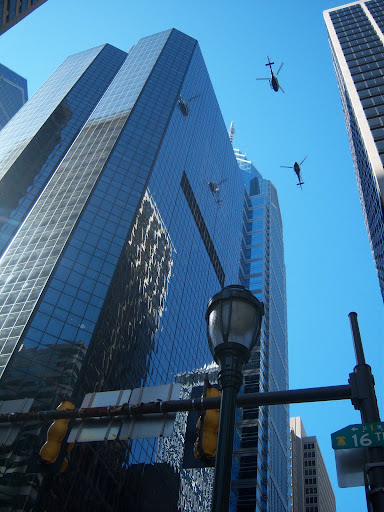
While the Film Office has been mostly hush-hush about the film’s details, to avoid a “paparazzi blitz,” the secret seems not all that carefully guarded. The film is an action flick starring John Abraham, Katrina Kaif, and Neil Nitin Mukesh, and its highly creative working title is “New York.” Although production began in August, the Film Office only this week revealed word of the film’s shooting in an effort to prevent the public from going on red alert over the dramatic scenes being shot over the weekend:

If you’re walking in Center City this weekend, near 16th and Market streets, don’t mind the FBI helicopters overhead or the sounds of gunfire.

“Don’t be concerned, it’s just a movie,” said Sharon Pinkenson, executive director of the Greater Philadelphia Film Office….

Continue reading at SAJAforum….

...wordpress...