September 2008 archive

SAJAforum: McCain and Obama Debate Afghanistan and Pakistan

The South Asian subcontinent continued to feature prominently in the presidential race this week, as Sen. John McCain and Sen. Barack Obama clashed over U.S. policy towards Afghanistan and Pakistan during their debate on Friday night. In the New York Times, David Sanger characterizes the exchange as a "role reversal," with Obama seeming "more aligned" than McCain "with President Bush’s current policy of authorizing American special forces to cross the Afghan-Pakistan border into Pakistan’s tribal areas that Al Qaeda and the Taliban have used as a sanctuary."

Video of the exchange to the right. Other reactions to the debate, along with excerpts from the debate transcript, after the jump.

Continue reading at SAJAforum….

McCain’s Blizzard of Words on Pakistan

(Posted at Dorf on Law)

Like a number of others, I did a series of double takes upon hearing some of John McCain’s comments on Pakistan during this exchange in last night’s presidential debate:

MCCAIN: Now, on this issue of aiding Pakistan… We’ve got to get the support of the people of — of Pakistan….

OBAMA: [T]he problem, John, with the strategy that’s been pursued was that, for 10 years, we coddled Musharraf, we alienated the Pakistani population, because we were anti-democratic. We had a 20th-century mindset that basically said, “Well, you know, he may be a dictator, but he’s our dictator.”

And as a consequence, we lost legitimacy in Pakistan. We spent $10 billion. And in the meantime, they weren’t going after Al Qaida, and they are more powerful now than at any time since we began the war in Afghanistan.

That’s going to change when I’m president of the United States.

MCCAIN: I — I don’t think that Senator Obama understands that there was a failed state in Pakistan when Musharraf came to power. Everybody who was around then, and had been there, and knew about it knew that it was a failed state. [link]

Perhaps McCain is being tutored on foreign policy by his vice presidential nominee, because I got lost in a hailstorm of nonsense there. McCain’s insistence upon the need “to get the support of the people of Pakistan” is all well and good — and I’m sure that the people of Pakistan would have welcomed that sentiment back in the winter, when Musharraf was trampling all over them. Instead, McCain unconditionally backed Musharraf at every turn, hailing the General as a “legitimately elected” president in the face of all evidence to the contrary. McCain even went so far as to call Musharraf a “scrupulously honest” man who had “done a pretty good job” and deserved the “benefit of the doubt” in the aftermath of his Emergency and Benazir Bhutto’s assassination. I do not know when, precisely, the moment was when McCain looked into Musharraf’s eyes and got a sense of the man’s scrupulously honest soul, but McCain’s character reference came several years after the Pakistani public got a good look for themselves, when the General brazenly reneged on a public promise that he would step down as army chief of staff.

But what should we make of McCain’s puzzling claim that Pakistan was a “failed state” before Musharraf’s 1999 military coup? The assertion goes well beyond defending the Bush administration’s unconditional support for Musharraf in recent years against Obama’s criticism. Rather, McCain necessarily seems to be asserting that Musharraf’s decision to overthrow Pakistan’s democratically elected government in the first place was justified. Failed States according to Fund for Peace/Foreign Policy, 2005-2007It turns out McCain has made this assertion before, asserting on the campaign trail in Iowa that Pakistan was a “failed state” before Musharraf came to power because it “had corrupt governments and they would rotate back and forth and there was corruption.” Of course, reasonable people can certainly disagree about how precisely to define a “failed state,” but it seems a stretch to put late-1990s Pakistan in that category. It’s also not as if Pakistan fared particularly well in this respect under Musharraf. At least according to the index developed by the Fund for Peace and Foreign Policy, Pakistan was at pretty serious risk of becoming a “failed state” during each of the last three years of Musharraf’s tenure as president. In any event, having “corrupt governments [that] rotate back and forth” certainly cannot be what defines a “failed state,” as McCain would have it. By McCain’s definition, one might conclude that India was a failed state in the late 1980s and again in the late 1990s.

McCain’s justification of Musharraf’s 1999 military coup is yet another example in which he seems to be singing a rather different tune than he was eight years ago. Recall that McCain was running for president when Musharraf overthrew Nawaz Sharif in 1999 — indeed, he was explicitly asked for his views about Musharraf’s coup in an interview only a few weeks later:

LARRY KING: How about military takeover bringing stability in Pakistan?

MCCAIN: Well, it may have brought some semblance of stability, but we only want the institutions of democracy that — to prevail in this and every other country in the world, and to have to resort to a military coup is not something the United States should support. The — I think [Gov. Bush's] point was that this was a very corrupt government that was overthrown, but it’s — in my view, it’s still not a reason to overthrow it. It’s a reason for us to do everything we can to help clean up that corruption and have the rule of law prevail in Pakistan and every other country in the world. [CNN, Larry King Live, Nov. 15, 1999, via Nexis]

UPDATE (9/28/08): Teeth Maestro rounds up some reactions to the debate by Pakistani bloggers at Global Voices.

UPDATE (9/30/08): Matthew Yglesias reports that he asked William Milam — who, as U.S. Ambassador to Pakistan at the time of Musharraf’s 1999 coup, “was certainly ‘around then’ and ‘had been there’” — for his view of whether Pakistan was a “failed state” before Musharraf assumed power. Milam’s response:

[W]hile there were a lot of things wrong in Pakistan during the years leading up to the 1999 military takeover, Pakistan was not a failed state as we normally define such states. I am on record as stating publicly that, having come to Pakistan from Liberia a year before the takeover, I had a pretty good idea of what failed states look like, and [Pakistan] was not one. [link]

SAJAforum: On the Sidelines of the UN General Assembly

Asif Ali Zardari, in a hugging mood with Manmohan SinghYesterday, Pakistan’s President Asif Ali Zardari and India’s Prime Minister Manmohan Singh met on the sidelines of the 63rd UN General Assembly session in New York:

[The leaders] agreed to kickstart an embattled peace dialogue between the two nuclear-armed rivals, with new talks to be scheduled by year’s end….

Singh and Zardari also decided to launch trading between the divided zones of the disputed Kashmir region from October 21….

The leaders agreed that a special meeting of a joint anti-terror mechanism be held next month to address "mutual concerns," including the bombing of the embassy, the statement said….

Singh and Zardari appeared satisfied as they emerged from the meeting.

In brief remarks, Singh praised Zardari’s vision for a progressive South Asia, saying they decided that issues be resolved through "peaceful" means.

Zardari called Singh the "architect of modern India," saying, "I hope to learn from him."

The meeting helped eased tensions, officials from both sides said.

"The leaders met for well over an hour, spent most of their time without aides and had a comprehensive discussion of the entire realm of issues in our relationship," Indian Foreign Secretary Shiv Shankar Menon told reporters….

According to the statement, crossborder trade will commence on the road between Srinagar and Muzaffarabad, capitals respectively of Indian and Pakistani zones of Kashmir, as well as the road from Poonch, in southern Indian Kashmir, to Rawalakot in Pakistani Kashmir. [link]

The text of their joint statement is available here.

The Singh-Zardari meeting, however, was overshadowed in the U.S. media by coverage of Alaska Gov. Sarah Palin‘s courtesy calls with visiting world leaders during her own trip to New York. South Asian leaders featured prominently in Palin’s schedule. While media access to Palin’s meetings was strictly limited,
journalists were able to get some access to Palin’s initial exchanges of pleasantries with the visiting heads of state.

Continue reading at SAJAforum….

SAJAforum: South Asian Women React to Sarah Palin

Aisha SultanSAJAer Aisha Sultan, the home and family editor of the St. Louis Post-Dispatch, has a column this weekend discussing what she calls the "Palin Paradox," the irony of Republican vice presidential nominee Gov. Sarah Palin’s intense support among social conservatives who, not long ago, might have "pilloried" a woman and mother who made the kinds of choices that Palin has made in her career:

Continue reading at SAJAforum….

NYC EVENT: SABANY/SAALT Lawyering for Social Change Series – Exploring the Rights of South Asians in the Workplace, Wed Sep 24 @ 6:30pm

Sep ’08
24
6:30 pm

South Asian Bar Association of New York (SABANY) & South Asian Americans Leading Together (SAALT)SIGN UP NOW for the next SABANY/SAALT
Lawyering for Social Change CLE Workshop

“Class & Work: Exploring the Rights of South Asians in the Workplace”

PROGRAM DESCRIPTION:
South Asians in the United States support the country’s economy by being employed in a range of occupations – from lawyers, doctors, and bankers to restaurant workers, taxiworkers, and domestic workers. Yet, many working-class South Asians confront significant legal challenges in the workplace, including exploitation by employers, threats of deportation, and denial of fair wages. During this interactive workshop, participants will learn about the range of legal obstacles that South Asian workers face; discuss the intersection of class and race; and learn how lawyers can provide their skills to assist individuals and organizations.

SPEAKERS:
Chitra Aiyar, Board Member, Andolan
Sheebani Patel, Organizer/Attorney, Restaurant Workers Opportunity Center of New York (ROC-NY)
Tushar Sheth, Attorney, Asian American Legal Defense & Education Fund (AALDEF)

* * *

Fordham Law School, 140 W. 62nd StreetDATE: Wednesday, September 24th
TIME: 6:30-8:00pm (note: earlier start and end time than last month’s session)
LOCATION: Fordham Law School, 140 W 62nd Street, Room 310 (note: the room number is different from last month’s session)

RSVP TO: lawyering.for.social.change@gmail.com with your name, school/employer, address, and phone number

COST: Free!

PERKS: CLE Credit (for those who attend the entire session) and free dinner!

Cosponsored by the South Asian Bar Association of New York (SABANY), Asian American Bar Association of New York (AABANY), South Asian Americans Leading Together, and the Fordham South Asian Law Students Association

DREXEL EVENT: Panel on Immigration Reform and Immigrant Workers’ Rights, Wed Sep 17 2008 @ 2:30pm

Sep ’08
17
2:30 pm

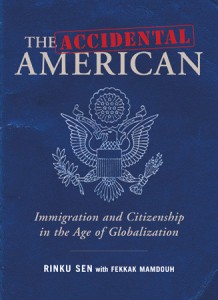
Rinku Sen with Fekkak Mamdouh, The Accidental AmericanJoin us on Wednesday, September 17th for a panel discussion on immigration policy and the challenges of organizing and advocating on behalf of immigrant workers, featuring Rinku Sen and Fekkak Mamdouh. In their new book, The Accidental American, Sen and Mamdouh “argue[] that, just as there is a free flow of capital in the world economy, there should be a free flow of labor”:

Author Rinku Sen alternates chapters telling the story of one “accidental American” — coauthor Fekkak Mamdouh, a Morrocan-born waiter at a restaurant in the World Trade Center whose life was thrown into turmoil on 9/11 — with a thorough critique of current immigration policy. Sen and Mamdouh describe how members of the largely immigrant food industry workforce managed to overcome divisions in the aftermath of 9/11 and form the Restaurant Opportunities Center of New York (ROC-NY) to fight for jobs and more equitable treatment. This extraordinary story serves to illuminate the racial, cultural, and economic conflicts embedded in the current immigration debate and helps frame the argument for a more humane immigration and global labor system. [link]

The discussion will be moderated by Prof. Anil Kalhan, and will be followed by a reception in the Second Floor Gallery.

* * *

Drexel University Earle Mack School of Law When: Wed, Sep 17, 2008, 2:30-4:30pm

Where: Drexel University Earle Mack School of Law, Rm 440 (reception to follow in 2nd Floor Gallery), 3320 Market Street, Philadelphia, PA

Sponsored by the Drexel University Earle Mack School of Law Chapter of the National Lawyers Guild. For more information, please contact Nicole Aiken or Ryan Miller at drexelnlg@gmail.com.

* * *

Previously: Five Questions for Rinku Sen (SAJAforum).

...wordpress...